
The Profitable Alphabet: First Arabic Content Writing & SEO Book

Most books about content writing focus on one thing: writing. They teach tone, structure, or how to craft a hook. But they rarely answer the question that every content writer in the UAE, KSA, or wider GCC region eventually faces: how do I write in a way that real people enjoy reading and that Google actually ranks?
That is exactly what The Profitable Alphabet (Al-Abjadiyyah Al-Murbihah) sets out to answer. Written by Basel Alameer Hasan, the founder of Wordian, a content and SEO consultancy serving businesses across the Arab GCC, this book is one of the most practical, well-structured Arabic-language guides to content writing and SEO published in recent years.
This article walks you through the entire book: what it covers, who it is for, the key lessons it teaches, and why it matters for anyone working in content writing in the GCC market today.
Download The Profitable Alphabet Now!
What Is The Profitable Alphabet?

The Profitable Alphabet is a practical reference book for Arabic-speaking content writers, marketers, and business owners. The full title in Arabic, Al-Abjadiyyah Al-Murbihah, translates roughly as “the alphabet that earns”, a nod to turning the basic letters you learned as a child into a real professional skill.
The book has nine chapters covering a wide range of topics: the psychology of persuasion, audience research, SEO fundamentals, all major types of digital content, writing craft skills, artificial intelligence in content work, common mistakes, and a comprehensive glossary of over 100 content and SEO terms.
It was written by Basel Alameer Hasan, who brings more than a decade of hands-on experience in content and SEO projects. The book is available through Wordian’s official website and serves as a companion to Wordian’s consulting and training services. It has received over 250 five-star reviews.
Why Arabic Content Writers in the GCC Need This Book
The Arabic content writing market across Saudi Arabia, the UAE, Qatar, Kuwait, and beyond has grown rapidly. More businesses are investing in digital presence, SEO, and content marketing. But the resources available in Arabic have not always kept pace. Most SEO and content writing guides are written in English, and direct translations rarely capture the cultural nuances that matter when writing for a GCC audience.
This creates a real problem. A content writer in Saudi Arabia or a digital marketer in Dubai who only reads English-language resources may learn the theory but struggle to apply it in the Arabic context: different audience behavior, different search habits, different idioms, and a very different relationship between formal and informal language.
The Profitable Alphabet fills that gap. It was written in the GCC context, for the GCC context. The examples are relevant, the language advice is practical for Arabic writers, and the SEO guidance is built on real experience working with GCC businesses, not theory imported from English-language SEO blogs.
According to HubSpot’s State of Marketing Report, content marketing generates three times as many leads as traditional outbound marketing. For businesses in the GCC that are still building their content strategy, this kind of advantage is significant. The Profitable Alphabet gives writers the tools to actually deliver that value.
Download The Profitable Alphabet Now!
Chapter by Chapter: What You Will Actually Learn
Chapter One: Before You Write, Read
The book opens with a principle that many writers underestimate: you cannot write well if you do not read consistently. The first chapter sets the mindset for the whole book. Content writing, the author argues, is not just about putting words on a page. It is about understanding what you are writing, for whom, and why.
Three rules frame this chapter. First: the hook is everything. Whether you are writing a blog post, a landing page, or a social media caption, your opening decides whether the reader stays or leaves. Second: do not write before you research. Writing itself is the last step; research, reading, and planning come first. Third: before writing anything, answer three questions, what am I writing, for whom am I writing it, and why.
The chapter introduces the four main forms of content (text, audio, image, and video) and the four main purposes of content (education, entertainment, inspiration, and marketing). Each form and purpose requires a different writing approach. An article writing service that understands these distinctions will always produce more focused, effective content.
Chapter Two: Do We Write for the Mind or the Heart?
This chapter tackles one of the most debated questions in marketing: are purchasing decisions driven by emotion or logic? The author presents both sides honestly. One school of thought says emotion comes first; the feeling sparks the desire, and then logic arrives to justify the decision. The other school argues that logic filters every emotion; facts and numbers come first, and feelings follow.
Rather than picking a winner, the chapter teaches writers to use both. The real skill is knowing when to lead with emotion and when to lead with logic. A skilled SEO content writer in the GCC does not pick a team, they learn to mix the two in a way that moves the reader toward action.
The chapter introduces the six persuasion principles of Robert Cialdini: scarcity, social proof, reciprocity, commitment and consistency, authority, and liking. Each principle is shown in a practical content context with clear examples of how to use it honestly, not manipulatively.
The chapter closes with twelve copywriting frameworks, from the classic AIDA to more advanced models like QUEST and PPPP. Each framework is explained step by step with practical examples. This section alone is worth the price of the book for anyone serious about website content and landing page writing or social media and advertising copywriting.
Chapter Three: For Whom Are You Writing?
This chapter is about audience research, one of the most important and most skipped steps in content writing. Writing without knowing your audience is like throwing words into the wind. They might land. They probably will not.
The chapter walks through three types of audience analysis: demographic (age, gender, location, income, education), psychographic (interests, values, lifestyle), and behavioral (preferred platforms, content types, interaction patterns). It then introduces practical tools for gathering this data, Google Search Console, Google Analytics, Reddit, Quora, and Google Trends, and explains how to build audience personas from the findings.
According to Semrush’s content marketing research, businesses that use audience personas in their content strategy see significantly better engagement results. The book connects this research to real writing decisions, not just data collection for its own sake.
The chapter also introduces Maslow’s Hierarchy of Needs as a content framework, showing how different levels of the pyramid correspond to different content goals. It then introduces the Content Funnel (ToFu, MoFu, BoFu) and explains how writing style, platform, and purpose should shift at each stage. A writer who understands the funnel writes with more intention at every step.
Chapter Four: Writing for Readers or Search Engines?
This is the most SEO-intensive chapter in the book, and it is excellent. The author does not treat SEO as a separate discipline that writers “add on” to their work. Instead, it is woven into the writing process itself.
The chapter opens with a memorable analogy: a restaurant in Beirut that makes the best pizza in the city, but it is hidden in an obscure neighbourhood no one visits. That restaurant is like good content without SEO. The quality is real, but the visibility is not.
It explains how search engines work across three stages (Discovery, Indexing, and Ranking) and introduces the four types of SEO: On-Page, Off-Page, Local, and Technical. Each type is explained with direct writing implications.
For On-Page SEO, the chapter covers Meta Titles, Meta Descriptions, heading structure (H1 to H3), internal linking, anchor text best practices, and image optimization including Alt Text. These are explained so that a writer, not just a developer, can actually apply them. The Pillar and Cluster content model is also introduced here as a practical framework for organizing a site’s content architecture.
For Technical SEO, the chapter covers site speed, mobile compatibility, XML Sitemaps, Robots.txt, HTTPS, and broken link handling. Writers who read this chapter will understand why technical SEO matters even when they are not the ones fixing it.
The chapter has a strong section on Local SEO, particularly relevant for businesses in the UAE, KSA, Qatar, and Kuwait. It explains Google Business Profile, NAP consistency (Name, Address, Phone), and why nearly half of all Google searches have local intent. For businesses offering services in a specific city or region, this section alone could change their approach to search visibility.
The chapter closes with a forward-looking section on GEO (Generative Engine Optimization) and AEO (Answer Engine Optimization): two concepts that are becoming critical as AI-powered search tools reshape how people find information. Appearing in search results is no longer enough. You need to be the source that AI tools cite.
Download the best book for content writing!
Chapter Five: You Need More Than One Pen
This is the longest and most practical chapter in the book. It covers every major type of digital content: website pages, landing pages, blog articles, UX writing, social media content, video scripts, podcasts, user-generated content, email marketing, newsletters, personal branding, company profiles, pitch decks, case studies, project proposals, and technical writing.
Each content type receives a dedicated section covering its structure, purpose, key writing elements, and common mistakes. The landing page section, for example, walks through every element, the hero section, the CTA, the trust signals, the urgency messaging, and explains what each one should accomplish.
The social media section introduces the Six Questions framework (What? How? When? Why? Who? Which?) as a tool for building monthly content calendars. The email marketing section breaks down the anatomy of a high-performing marketing email. The chapter also covers translation, proofreading, and transcreation as a distinct skill set for content writers handling bilingual or multi-market projects.
For product-focused businesses and e-commerce SEO, the chapter explains how to write product descriptions that serve both the reader and the search engine: benefits over features, clear keyword use, and clean structure. This is relevant to any online retailer in the GCC investing in organic search growth.
The chapter closes with a practical section on content repurposing: how to take a single piece of content and transform it for multiple platforms and formats without starting from scratch every time.
Chapter Six: Skills No Content Writer Will Tell You About
This chapter covers the skills that separate average writers from excellent ones, and most of them are not taught in writing courses.
Three groups of skills are covered: core writing skills (research, language intelligence, writing speed), career development skills (multilingual writing, attention to detail, client management), and reader engagement skills (writing hooks, crafting headlines).
The research section argues that unreliable sources are like a bad foundation: the structure collapses eventually. It covers three source types (primary, secondary, and fieldwork) and shows how keyword research is part of the research process itself, not a separate SEO task added at the end.
The section on working with clients is refreshingly honest. Six client types are described, the decisive client, the unclear client, the interfering client, the always-in-a-hurry client, the undervaluing client, and the partner client, with practical strategies for each. Setting clear expectations, documenting agreements, and protecting your work quality are treated as professional necessities, not optional extras.
The hooks section (for video and short-form content) and the headlines section are both detailed and example-rich. Writers who internalize this chapter will produce noticeably stronger opening lines across every content format they work in.
Chapter Seven: Artificial Intelligence, New Friend or Enemy?
This chapter addresses AI honestly and without panic. The author acknowledges the concern: tools that produce articles, social posts, and landing pages in minutes do feel like a threat to writers. But he draws a useful historical parallel: when the internet arrived, everyone predicted the end of print journalism. It did not end. It adapted.
The chapter’s argument is clear: AI is a productivity tool, not a replacement for a skilled writer. What AI lacks is the ability to understand local context, build a genuine voice, write from personal experience, or produce content that creates real emotional connection with a specific audience. A content agency in the GCC that understands this distinction uses AI to work faster, not to lower the quality of its output.
The chapter provides four practical AI prompt templates: C-L-E-A-R, P.A.R.A, I-A-I, and T-A-G. Each is designed to help writers get more useful, specific outputs from AI tools instead of generic, repetitive text.
The final section covers how to review and humanize AI-generated content. It lists the specific patterns that reveal AI writing: opening cliches, overuse of certain vocabulary, triple-structure sentences, and hallucinated statistics. Any writer regularly using AI tools will find this section immediately useful.
Chapter Eight: Common Mistakes in Content Writing
This chapter organizes the most common content writing mistakes into five categories: planning and strategy mistakes, message and content mistakes, structure and phrasing mistakes, publishing mistakes, and ethical and professional mistakes.
Common mistakes covered include: writing for everyone instead of a specific audience, writing without a clear goal, focusing on features instead of benefits, ignoring the emotional dimension of the content, and failing to adapt content to each platform. The chapter includes a before-and-after format for many examples, making the corrections easy to understand and apply.
The ethical section covers content theft and plagiarism, making promises a product cannot keep, and fabricating statistics or citations. These are treated as practical threats to long-term brand credibility. A structured SEO audit often uncovers content making these exact mistakes, and addressing them is one of the fastest ways to improve both rankings and reader trust.
Chapter Nine: The Language of Content, A Glossary
The final chapter is a comprehensive glossary of over 100 content writing and SEO terms, explained in clear, practical language. It covers everything from Content Strategy and the Sales Funnel to Canonical URL and Schema Markup.
This glossary is genuinely useful for Arabic-speaking professionals across the GCC who work in environments where English terms are used daily but not always well understood. For anyone handling bilingual content or working with translation and transcreation services, this section provides clear anchors for the shared vocabulary used across the industry.
Download the best resource for content and SEO!
Key Lessons for Content Writers and Businesses in the GCC
After reading all nine chapters, several lessons stand out as especially relevant for the GCC market specifically.
Good content and good SEO are not opposites. The book’s central argument is that content written for real readers also performs well in search, if you understand how search engines evaluate content. According to Moz’s research on search ranking factors, content quality and user engagement are among the strongest signals in Google’s ranking algorithm. The Profitable Alphabet helps writers understand this connection rather than treating SEO as an afterthought.
Audience research is the foundation, not an optional extra. Many businesses in Saudi Arabia, the UAE, and Kuwait publish content regularly without results because the content is not connected to what their actual audience is searching for. The book’s frameworks for audience personas, psychographic analysis, and the Content Funnel give both writers and business owners a clear process for fixing this.
Arabic has specific challenges that English-language SEO guides do not address. The book acknowledges the complexity of writing in Arabic for search: the difference between Modern Standard Arabic and regional dialects, the right-to-left text direction in UX writing, and the cultural context that shapes which persuasion approaches work. These are not details, they are central to whether GCC audiences actually engage with content.
AI is a tool, not a replacement. The chapter on AI is one of the most balanced treatments of this topic in any Arabic-language resource. Writers who are anxious about AI will find reassurance. Writers who are already using AI will find practical guidance on using it better.
Professional skills matter as much as writing skills. The sections on client management, setting boundaries, and documenting agreements treat content writing as a real professional practice, not just a creative activity. This perspective is especially valuable for freelancers and agency teams dealing with complex client relationships across the GCC.
What Makes This Book Different from Other Content Writing Resources
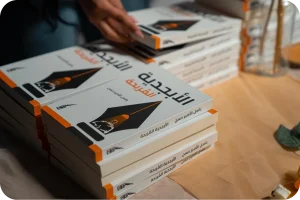
There are hundreds of content writing and SEO books available in English. What makes The Profitable Alphabet worth reading, even for someone who can access English resources?
First, it was written from the GCC. The examples, the cultural references, the client types described in Chapter Six, the way Arabic writing is discussed, all of it reflects direct experience in the Arab GCC market. Generic advice that works in a US market may not translate to a Syrian, Emirati, or Saudi audience.
Second, it integrates writing and SEO without making either feel secondary. Most content books are either about writing craft (with minimal SEO) or about SEO technique (with minimal writing quality). This book treats them as a unified skill set, which is the reality for anyone working in the field today.
Third, the glossary in Chapter Nine is unusually comprehensive for an Arabic-language resource. Arabic-speaking professionals who work in environments where English SEO and marketing terms are used daily now have a reliable reference for what those terms mean and how they connect.
Fourth, the book was written by Basel Alameer Hasan, who runs a content and SEO consultancy that has delivered hundreds of consulting sessions and practical projects across the GCC. The practical orientation comes through on every page. The training services that Wordian offers are built on the same principles this book teaches, which means everything in it has been tested with real teams and real clients.
Who Should Read The Profitable Alphabet?
The book is genuinely useful for several different reader types.
- Content writers in the UAE, KSA, Qatar, and beyond who want to understand SEO without learning to code. Chapter Four alone will transform how you approach every piece of content you write.
- Marketing managers and brand teams in GCC companies who are building or reviewing their content strategy. The chapters on audience research, the content funnel, and content types give you a clear planning map.
- Business owners who are creating their own content or working with a content team for the first time. The book explains clearly why content works when it does and why it fails when it does not.
- Agency teams working in content or digital marketing. The book is practical enough to be used as a reference in real project work, not just professional development reading.
- Freelancers who want to professionalize their content writing practice and understand SEO at a level that supports better rates and better client relationships.
The book is probably not the right fit for someone who is already an advanced SEO specialist or who reads English-language SEO resources daily. It is designed for the large audience of Arabic-speaking professionals across Syria, Lebanon, Jordan, Saudi Arabia, the UAE, and the wider GCC who have not had access to this kind of integrated, practical guide before.
How Wordian Brings This Book to Life
The Profitable Alphabet is not just a book. It is a reflection of how Wordian approaches content and SEO work with every client. The same principles that fill these nine chapters guide the practical work the team does every day.
Wordian offers 60-minute consultation sessions that diagnose specific problems such as weak engagement, indexing issues, on-page errors, and traffic drops. Each session ends with a clear, actionable plan. The analytical framework in the book is the same one applied in these sessions.
The team also works with agencies and internal marketing teams through structured training programs that evaluate workflow, identify production weaknesses, and improve how content and SEO decisions get made. The emphasis is always on connecting content output to actual performance, not just page count.
For businesses that need hands-on help, Wordian’s full range of writing and SEO services covers both production and execution: from writing articles, website pages and landing pages, and social media content, to running technical SEO audits, improving on-page elements, and building local search visibility for GCC businesses. Everything is approached with the same integrated mindset the book describes.
If you want to discuss how the ideas in this book apply to your specific situation, you can reach out directly or message via WhatsApp. Wordian works 100% remotely and serves businesses across the GCC with real applied experience.
To read more articles on content writing and SEO for GCC businesses, visit the Wordian blog or read about the team on the About Wordian page.
Ready to Turn Your Content Into a Real Asset?
The Profitable Alphabet makes one thing very clear: content that is not built for both readers and search engines is working at half its potential. If your website content, blog, or social media presence is not delivering the results you expect, the gap is usually in one of three areas: audience research, SEO fundamentals, or the quality of the writing itself.
Wordian helps businesses across the GCC close that gap. Here is what is available:
- Content writing services: articles, website pages, landing pages, social media content, and more
- SEO audit and crawling: a full diagnostic of what is holding your site back
- On-Page SEO: fixing the elements inside your pages that affect rankings
- Technical SEO: site structure, speed, and indexing improvements
- e-Commerce SEO: organic growth for online stores in the GCC market
- Consultation sessions: a focused 60-minute session to diagnose your situation and build an action plan
Wordian is a content and SEO consultancy in the GCC that works 100% remotely and brings real applied experience to every project. If your content is not working as hard as it should, let’s fix that.
Frequently Asked Questions
What is the main difference between content writing and copywriting?
Content writing focuses on educating, informing, or engaging an audience, articles, blogs, and website pages are classic examples. Copywriting is specifically designed to persuade someone to take an action, such as purchasing a product or signing up for a service. Strong SEO content writing in the GCC combines both: it informs readers clearly while guiding them toward a decision. The Profitable Alphabet dedicates an entire section to this distinction, with a comparison table covering goals, content types, required skills, and measurement tools.
How does the book explain SEO to non-technical writers?
The book uses clear analogies rather than technical jargon. The core explanation is this: a great restaurant in a hidden neighbourhood will stay empty if no one knows it exists. Content without SEO has the same problem. Chapter Four explains how search engines discover, index, and rank pages in plain language, then connects each concept directly to what a writer should do: where to place keywords, how to structure headings, what makes a good Meta Description, and why internal linking matters. Wordian’s own On-Page SEO service is built on exactly this kind of practical, content-focused optimization.
Is The Profitable Alphabet useful for businesses, not just individual writers?
Yes. The book is structured so that business owners, marketing managers, and content teams across Saudi Arabia, the UAE, Kuwait, and beyond can all extract value from it. The audience research frameworks, the content funnel model, and the chapter on content types are especially useful for businesses planning or reviewing their content strategy. The chapters on common mistakes and measuring content performance are practical for anyone managing a content operation, not just people doing the writing.
What is GEO and why does a content writer in the GCC need to know about it?
GEO stands for Generative Engine Optimization, making content visible and usable within AI-powered search responses from tools like ChatGPT, Gemini, and Perplexity. AEO (Answer Engine Optimization) focuses on structuring content to appear as direct answers in featured snippets and “People Also Ask” boxes. Both are growing in importance as AI search reshapes how people find information. Any serious SEO content writer in the UAE or KSA working today needs to understand these concepts, not just traditional keyword-based SEO. The Profitable Alphabet covers both clearly in Chapter Four.
Does the book cover how to use AI tools for content writing?
Chapter Seven of The Profitable Alphabet covers this in practical detail. It explains four prompt templates (C-L-E-A-R, P.A.R.A, I-A-I, and T-A-G) for getting better results from AI tools. It also covers how to review and edit AI-generated content to remove the patterns that reveal it as machine-generated: clichéd opening lines, overused vocabulary, and invented statistics. The chapter’s core message is that AI is a productivity partner, not a replacement for a skilled writer.
What types of content does the book cover in depth?
Chapter Five covers a wide range: website pages and landing pages, blog articles, social media content including captions, carousels, and Reels, email marketing and newsletters, video scripts, podcast scripts, company profiles, investment pitch decks, case studies, project proposals, technical writing, and content repurposing strategies. Each type gets a dedicated section with structure, purpose, and key writing elements explained.
How does The Profitable Alphabet approach writing in Arabic for SEO?
This is one of the areas where the book is most valuable. Most SEO guides are written in English and do not address the specific challenges of Arabic content: the difference between formal and informal Arabic, the right-to-left text direction in UX writing, or the cultural context that shapes persuasion in GCC markets. Basel Alameer Hasan writes from direct experience working with Arab GCC clients, so the guidance reflects that context specifically rather than being adapted from English-language advice.
What is the Content Funnel and how should GCC businesses use it?
The Content Funnel describes the journey a reader takes from first discovering a brand to becoming a loyal customer. The three main stages are ToFu (awareness), MoFu (consideration), and BoFu (decision). Each stage needs different types of content: ToFu content should spark curiosity and introduce the brand; MoFu content should build trust and help the reader compare options; BoFu content should directly address objections and prompt action. A business in Riyadh, Dubai, or Kuwait City that understands this structure will plan content that works at every stage of the customer journey, not just at the point of sale.
How long does it take to see results from an SEO content strategy?
This depends on the site’s current authority, the competitiveness of the keywords targeted, and the quality and consistency of content being published. For most GCC businesses starting from a low base, visible improvements in organic traffic typically begin appearing within three to six months of consistent, well-optimized content. Technical fixes, crawl errors, page speed, indexing issues, can show results faster. Treating content as a long-term investment rather than a one-time project is essential. A structured SEO audit is often the right first step to understand what is holding a site back.
Where can I get The Profitable Alphabet and Wordian’s other resources?
The book is available through Wordian’s website. Wordian also offers consultation sessions, team training, and a full range of content writing and SEO services for GCC businesses. For more reading, visit the Wordian blog or contact the team directly.